

Why Battery Testing Matters
Your car's battery is essentially a silent workhorse. Most of the time you don't think about it — until it doesn't work. But here's the thing: you don't have to wait for a dead battery to find out there's a problem.
A good battery test catches issues before they strand you on the road. Technicians use specific measurements to determine whether your battery's actually healthy or just pretending to be. We're going to walk you through exactly what those tests are, what the numbers mean, and why they matter for your vehicle.
Voltage Testing: The First Check
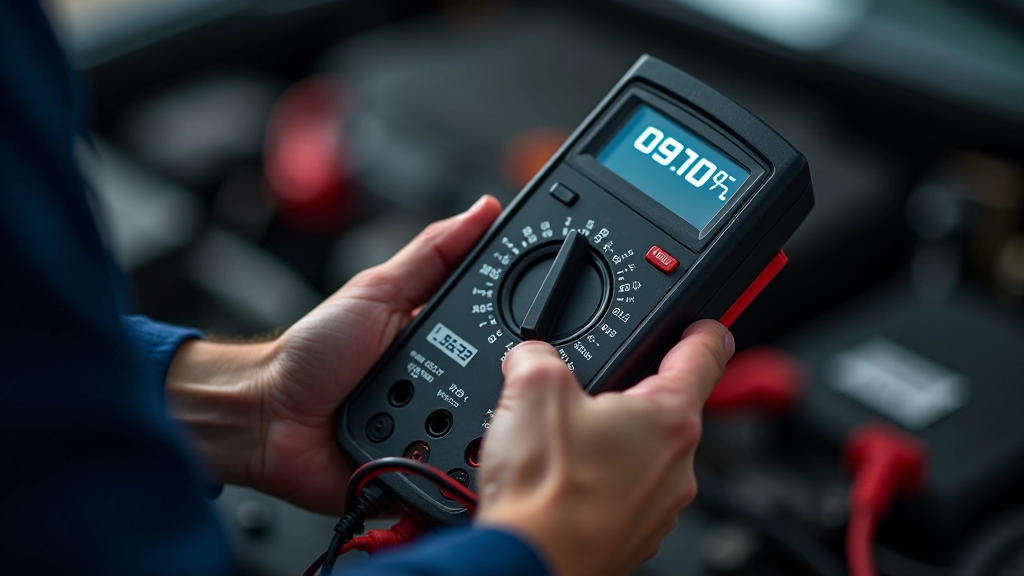
The most basic battery test is a voltage check. Technicians use a multimeter — that's the handheld device with the digital display — to measure how much electrical potential your battery's actually storing.
A healthy battery at rest sits between 12.4 and 12.8 volts. Not 13, not 14 — that specific range. If it's reading below 12.4 volts when the engine's off, the battery's already partially discharged. Below 12 volts? It's struggling.
When you start the engine, voltage should jump to around 13.5 to 15 volts. That's the alternator kicking in and charging the battery. If it doesn't climb up when the engine runs, you might have an alternator problem instead of a battery problem — and that's a completely different repair.

Cold Cranking Amps: The Real Stress Test
Here's where things get interesting. CCA — cold cranking amps — measures how much current your battery can deliver at freezing temperatures. This is what actually starts your engine, especially on cold mornings when everything's harder.
Every battery has a CCA rating printed on it. A typical car battery might be rated for 600 CCA. Your engine needs a certain minimum CCA to actually turn over. If your battery's CCA rating drops below that threshold, it won't reliably start your car — particularly in winter.
A load test simulates what happens when you turn the key. The testing equipment draws current from the battery at a specific rate for a specific time — usually 15 seconds — while measuring voltage drop. If the battery can't maintain adequate voltage under that load, it's failing.
Disclaimer: This article provides educational information about battery testing procedures and what results typically indicate. It's not a substitute for professional automotive diagnosis. Battery and electrical system issues can vary significantly between vehicles. Always have testing performed by a qualified technician who can properly evaluate your specific vehicle's condition and recommend appropriate repairs or replacements.
Load Testing in Practice
Load testing is more thorough than a simple voltage check. A technician connects a device that draws power from the battery while monitoring voltage. They're essentially asking: "Can you actually do your job under pressure?"
The equipment typically pulls a load equal to half the battery's CCA rating for about 15 seconds. Throughout that period, the voltage should stay above 9.6 volts. If it drops below that, the battery's failing. If it stays above it, the battery passes.
Voltage check at rest (12.4-12.8V indicates health)
Load test equipment connected to battery terminals
Load applied for 15 seconds while monitoring voltage
Results compared to battery's CCA rating and specifications


Reading the Results
So what do you actually do with these numbers? Here's the practical translation:
Battery passes: Voltage stays above 9.6V during load test. You're fine. Your battery's good for now.
Battery fails: Voltage drops below 9.6V under load. It's time for a replacement. The battery can't reliably start your car, especially in cold weather.
Voltage too low at rest: Below 12.4V with engine off usually means the battery's been partially discharged. Sometimes it's just from sitting unused. Sometimes it's from a parasitic drain. Sometimes it's an alternator that's not charging properly.
The good news? Testing takes maybe 10 minutes and usually costs nothing or next to nothing. Most shops include it with regular maintenance checks.
Know Before You're Stranded
Battery testing isn't mysterious. Technicians are measuring two things: can your battery hold a charge, and can it deliver power when you actually need it? A voltage check answers the first question. A load test answers the second.
Understanding what these tests mean puts you in control. You're not guessing whether your battery's good or just hoping it doesn't fail. You've got actual numbers. And those numbers tell you whether you need a replacement now or whether you've got more time.
Next time a technician tells you your battery's failing a load test, you'll know exactly what that means — and why it matters for your car's reliability.